
I can't stop thinking about Minnesota
A year in Minnesota: what you can't know from the news

I have to process this or I won’t be able to sleep tonight.
Last night, I sprung wide awake in the middle of the night: I can’t stop thinking about Minnesota. I am heartbroken. I am panicked. I am afraid. I can’t stop watching reels. I feel so incredibly powerless.
But I guess what I can offer is a perspective on Minnesota from an outsider who tried to belong.
I lived in Saint Cloud, Minnesota from July 2024 to March 2025. My short time in Minnesota feels like a fever dream— something that happened to someone else. It’s hard to believe that I spent close to a year in Central Minnesota: it was the most isolating year of my life. But I have to believe that I was plopped there with reason: to translate a place that is hard to explain unless you’ve lived here.
I had never lived in a place like Saint Cloud— a big small town in red county locked in the middle of a state. I can’t claim to know everything about Minnesota, and there are things I am bound to get wrong (and if I do, I encourage you to speak up! I am eager to corrected). We were placed there because my husband-to-be got a fellowship. It was only ever going to be for one year. But we were also placed in rural central Minnesota because he is a tall, Midwestern looking white guy: he looked like he belonged.
And in Central Minnesota, looking like you are from there matters.
Minnesota is a hard place to conceptualize if you haven’t been there. Before we moved, I couldn’t even conjure its landscape in my mind: I had heard about the tunnels between buildings because it gets cold. I had heard about “Minnesota Nice.” But I was wholly unprepared for what Minnesota feels like.
I have spent the majority of my life in either LA or New York (with a nine month stint in Chicago), and so you could call me a “Bi-Coastal Elite.1However, that phrase makes me want to throw up in my mouth, and whoever identifies with that phrase definitely has a personality disorder. The last thing I ever want to frame myself as is an “Elite”, but I do come from a family with money, and after 10 years in New York sandwiched by childhood and a few years of adulthood in LA: the shoe can fit.
What You Can’t Know: I was treated like an outsider the entire time I lived in Saint Cloud.


Everyone in Saint Cloud knows everyone. If you are not of Scandinavian or Germanic descent, you are an outsider. If you are not Catholic, you are an outsider. If you didn’t go to Kindergarten with them, you are an outsider. If their parents didn’t know your parents, you’re an outsider. If their grandparents didn’t know your grandparents, you’re an outsider. And so on. Maybe this is a general small town thing, but I wouldn’t know.
But what I do know: I was treated like an outsider the entire time I was lived in Saint Cloud.
There were a few people willing to socialize. But only a few. They’d be civil to my face, but it wasn’t like they were hitting me up often. My most consistent friendships were with a twelve year old and a fourteen year old in my building, who knocked on my door the day before Halloween asking for candy. I had none, panicked. Gave them a cookie I had just baked (I did A LOT of baking that year), and the interaction ended with the twelve year old asking, “Can I give you a hug?”
They came to my door often, late at night. Each time, they entered deeper and deeper into my apartment. A month or two in, they were sitting in my office, sharing their deepest secrets and hurts with me. They were both girls who were tiny children during the pandemic. Under-supervised by their parents and over-stimulated by their phones. Self-harm was their primary means of self-regulation. I felt wholly out of my depths, holding the information they shared with me, but I grew to love them so deeply.
And the truth: I was so fucking lonely. I was so, so fucking lonely.
They were the only two people in town who consistently wanted to hang out with me and didn’t treat me like I was trying to invade their space. They hadn’t been taught to fear me yet.
I am a white girl who has never been treated like she was a threatening force— a function of being white, a privilege, but also a function of the fact that my vibe is big time SUNSHINE BEAM. Before that year, I had never struggled to make a friend in my life.
When I went to Target, people would jump when I walked into an aisle they were browsing. I am in the recovery community, and I falsely thought I could find belonging there. In a room of 50, only two said hi to me consistently. I was ignored. I would soon learn that “Minnesota Nice” does not mean warm, it means polite. Distant, but civil. I was consistently held at arms length.
Around January, I hadn’t seen the girls in a while. I got a text to meet them in a common space in our building. But when the 14 year old’s little sister walked past, she yelled “HIDE!” I was confused, realizing that this was strange, until she told me: her mother told her they weren’t allowed to see me because she was afraid I would kidnap them.
Stranger Danger: Jacob Wetterling
Saint Cloud Minnesota is the epicenter of the concept of “Stranger Danger”.
In 1989, 11 year-old Jacob Wetterling was abducted and murdered in Saint Joseph, the even smaller neighbor to Saint Cloud. Prior to that moment, kids rode bikes to and from their local stores and friends houses. Doors were unlocked. There was a general sense of safety.
But when Jacob Wetterling went missing: everything changed.
It wasn’t until I left Minnesota that I started to learn about this deep-seeded fear of outsiders coming in and abducting Minnesotan children. I was on the treadmill, walking and listening to In The Dark, A New Yorker podcast series laying the case out, step-by-step, complete with interviews with Patty Wetterling discussing the after-effects of her legislation.
Missing for decades, the case of Jacob Wetterling imprinted the Fear of God into every Minnesotan from theretofore. His mother, Patty Wetterling, was galvanized into action, creating the Wetterling Act, which created the sex offender registry.
There is a lineage of normal Minnesotans springing to action and creating impactful change (We Love You Tim Walz), and Patty Wetterling is no doubt one of them. There are so many people-centered laws in Minnesota, that I couldn’t help but marvel at the efficiency of the state. When it is warm, there is constant road construction, fixing potholes. If you wear glasses, they will not accept a prescription older than two years. And no doubt, all of this is done with people in mind. ( I would also learn that even if you have it good, people will complain: The Minnesota State Fair Booth hating on Tim Walz. A tshirt with Mao, Stalin, and Walz in profile, with the phrase ‘One Man’s Neighborliness is Another Man’s Goulag.’ People will even take issue with feeding kids lunch at school just because it’s something to complain about).
But I learned, even Patty Wetterling had some doubts about the registry she helped create: the culture of fear and the lack of restitution did not stop crimes from happening.
In 2016, Jacob’s remains were found after the confession of the murderer, Danny Heinrich. In this case, he was a stranger. But more often than not, when it comes to sexual crimes: it is more often someone you know.
But I didn’t know this background. I did not grow up in Minnesota, so I did not remember the great Halloween blizzard in the nineties, nor did I have any lasting memory of when Jacob Wetterling went missing.
So at that time, it felt insane for the mother in my building (who I never actually met because her daughter was insistent that if I met her, she would get in trouble “She can’t know that you know where we live!” When, in fact, she lived down the hall from me).
What struck me as odd is that I would have picked up her daughter from school, driven her to the extracurriculars she had to give up because her mother had to work. These girls, only finding community at church because that was all that they were offered for free, all that was offered as consistent community. I was already providing a safe container for these girls to share their whole selves, and I would’ve driven them to church.
If I could go back and do it differently, I would have introduced myself immediately. I recognize my mistake. I waited too long, and by the time that it became imperative to introduce myself, it was too late.
But what is so eery— how I usually conduct myself went out the window. I was so disoriented in the Stranger Danger landscape, that I couldn’t rely on my normal ease of being.
But I was an outsider, so it didn’t matter how I handled it.
Minneapolis as Safe Haven


Every Saturday, I drove an hour and a half both ways to attend a meeting in South Minneapolis. I didn’t totally enjoy my time in Minnesota, but that doesn’t represent the deep love and respect for the place and its people— especially Minneapolis.
Every Saturday, I woke up at 7 to make the drive to the Twin Cities: it felt like a safe haven. I would walk into a room of people who remembered my name, who would hug me. A friend having gone to Saint John’s, commiserating about the vibe that makes outsiders feel so incredibly alienated. Validating the feeling that felt so hard to claim while I was there. I made friends. They accepted me with open arms.
Sometimes, I’d drive into the city on weekdays so that I could breathe. Every time I made the trek, I could survive Saint Cloud for the five days after. I felt the life drain from me, day-by-day, after the visit. And back I would go: driving 80 miles to get a sense of reprieve. To feel like I wasn’t alone.
What Scared Me Most
I am a white girl who looks like a middle school desk, covered in tiny tattoos and doodles. But what about the people who do not look like me?
In the 1980’s and 90’s, Somali refugees arrived in Minnesota fleeing Civil War. The Twin Cities is home to 80-100,000 Somalis, which is the largest concentration of ethnic Somalis outside of Somalia.
The racism and xenophobia was palpably crackling under the surface. In Saint Cloud, I watched as women got haughty at checkout with a teenage Somali wearing a hijab, just trying to scan her batteries. Enduring, just pushing through the interaction to the end. Quietly enduring. I can’t begin to say that I understand that experience. I witnessed things, but I had no conversations with anyone to say: “I saw that.” I regret that.
All the while, I was being treated as if California was just as far as Somalia.
“Is California as bad as they say it is?” A used furniture salesman asked me.
I wanted to ask: “Who told you that?”
But then it became obvious: Fox News.
What is Obvious
I am paralyzed by the violence that Minneapolis is being forced to endure at the hands of a militarized force that is funded by our government.
I am PARALYZED at the thought of under-trained, over-armed men taking to the streets, dragging people from cars on the way to the doctor o the way to school.
I am terrified that the city is in lockdown: no school, no work, no nothing. Because no one is safe. Citizenship does not protect you from the American Gestapo.
Mostly: I am paralyzed by the way in which Fox News is condoning state-sanctioned violence.
What Is Not As Obvious
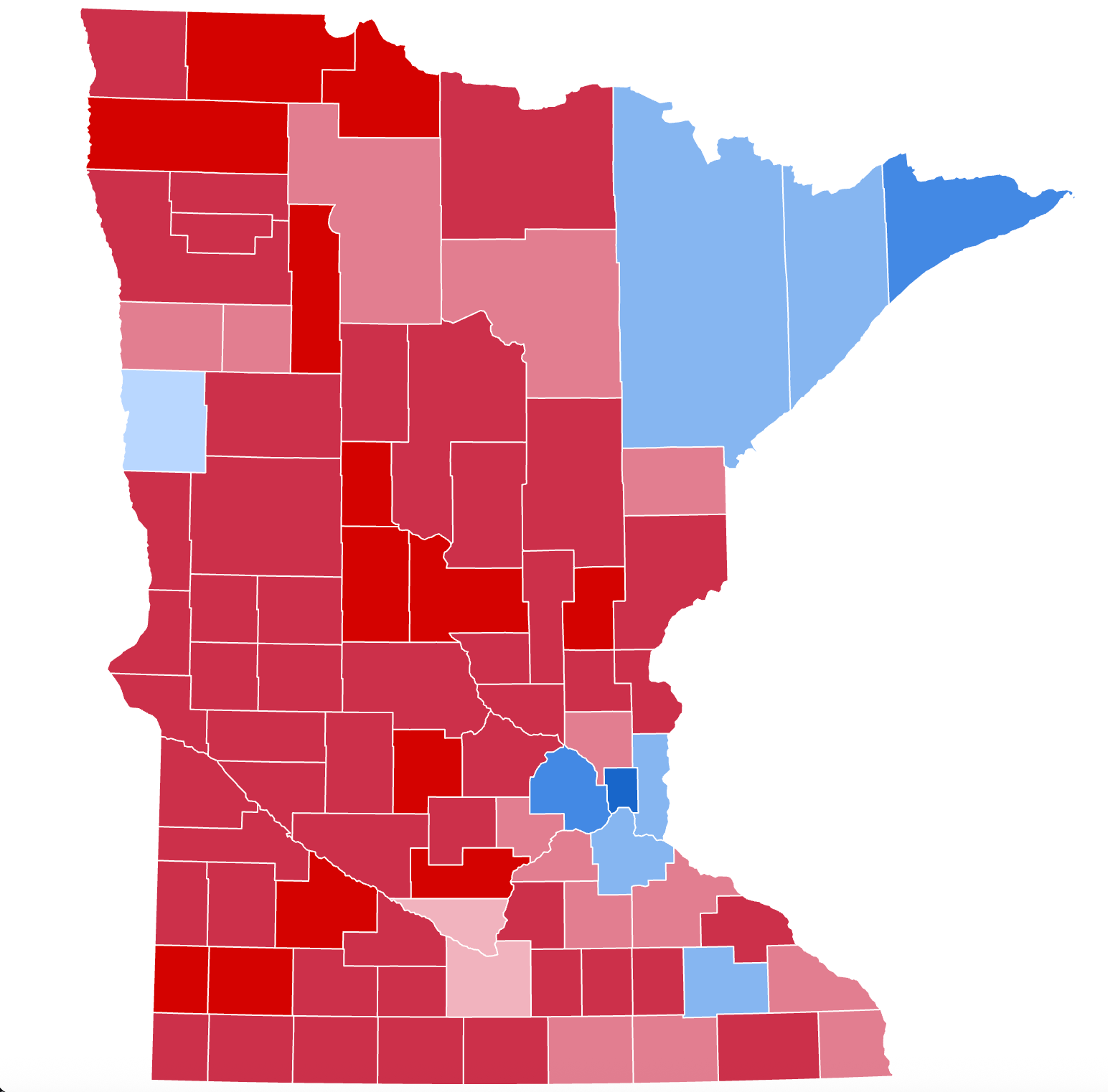
I am terrified by the way in which enacting violence on Minneapolis is going to not only terrorize a population, but also the way in which it will cement a narrative that is being told around the remaining state.
The majority of Minnesota’s population lives in the Blue Cities, hence why the state goes Blue. But when you look at the voting map for 2025: it’s hard to see how much empty space is populated by people ruled by fear.
Because that is what Fox News Viewers are: ruled by fear.
Since 2016, they have been systematically taught to distrust every other form of media [FAKE NEWS], so much so that they are reliant on the greatest propaganda machine. They are being told: A woman was shot in the face, but she deserved it. And they believe that. Kristi Noem framing Renee Nicole Good as a domestic terrorist, the fact that Fox News viewerrs believe that ANTIFA is an organized force. When reality, it just means: Anti Facism.
Because why wouldn’t they trust Fox News? They’ve been trusting it for a decade.
Since 2020, the Twin Cities has a reputation for looting and destroying their own city in response to George Floyd. In my mind, dropping ground and escalating in Minneapolis is tactical. The foundation has been laid by 2020: these are crazy, unruly, violent people.
The irony? The militarized force that is enacting the violence is seen as LESS VIOLENT than civilians.
Renee Nicole Good was a poet from Colorado— an outsider like me. But she found home in Minneapolis. She tried to defend her neighbors. But when she tried to move away— changed her mind— she got shot.
You can say, “I’m not mad at you,” and still get shot in the face and called a “Fucking bitch.”
What is hard to explain and see is that, in Minnesota, there is a deep culture of deep distrust and fear of outsiders: and the fear and distrust has found a partner with the hate and violence that ICE is enacting.
And I can’t sleep. I can’t sleep knowing what that distrust and fear felt like on a bodily level.
And I don’t know what else to do but process.
I left. I am back in California. And yet, my neighbors are being abducted too.
Maybe this will help someone understand. Maybe this will help.
Thank you for reading. If I got anything wrong, let me know in the comments. I want to open this discussion, I am not an expert. Just reporting what I witnessed.
Typos are proof that I didn’t use AI
Thanks for sharing your experience. Welcome home. In a few years are people going to look back on this era and wonder how we could let this happen? That’s what I am thinking when I hear about the Holocaust-why did they let it happen?
This is stunning. I can feel the rawness in this. Thank you for sharing this.